The power of gratitude

De kracht van dankbaarheid
BLOG

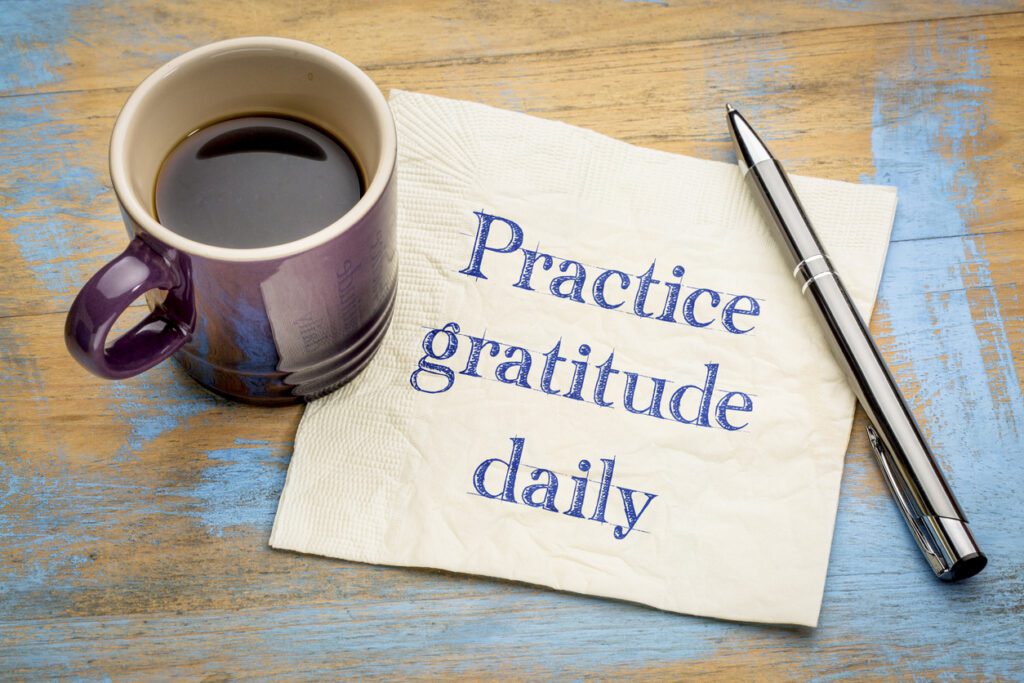
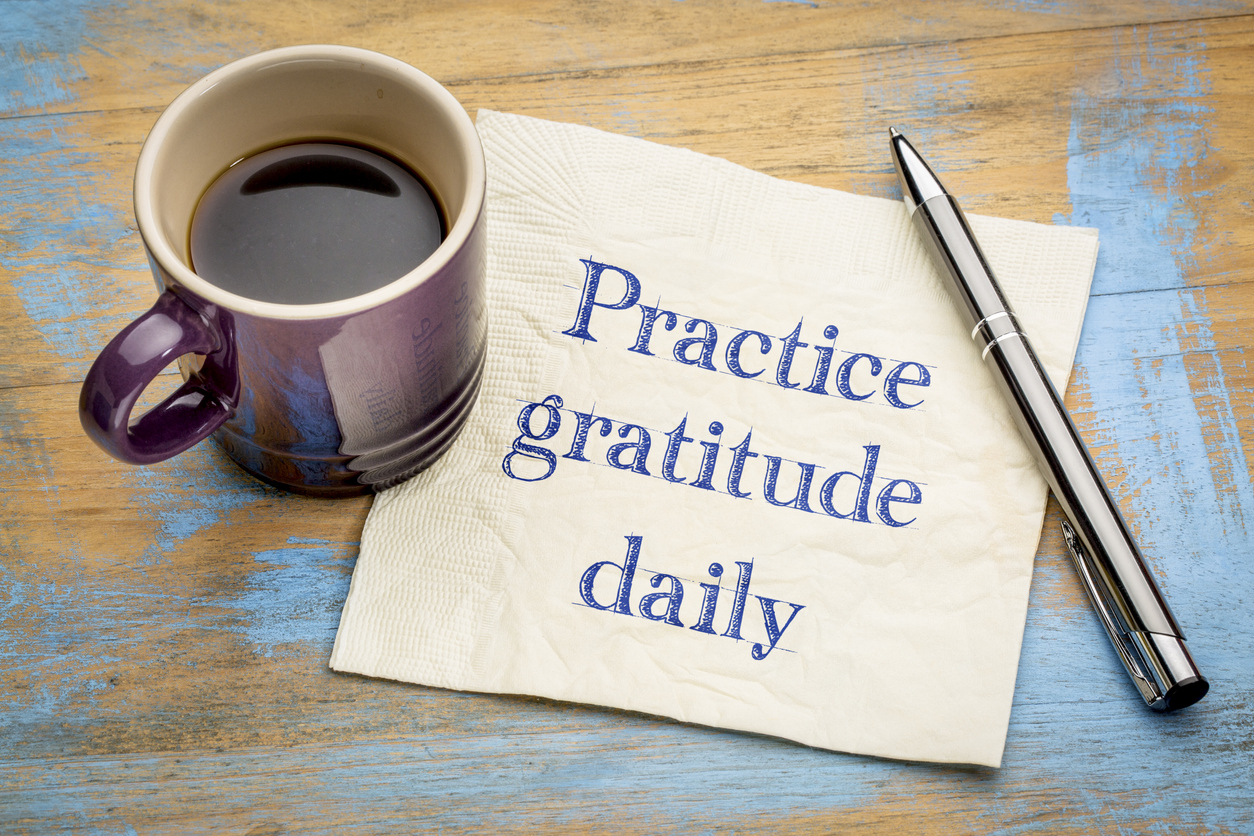
The power of gratitude

We all clearly remember our parents or a grandparent saying to us, "What is the magic word? Usually it meant "please". But there is another transnational magic word, namely, "Thank you". Who would have expected simple words to have so much power? Showing appreciation and acknowledging gratitude in others can be purifying.

Since ancient times, philosophers have praised the benefits of living a life of gratitude. But you don't have to be Socrates to understand that being grateful and showing appreciation contributes to overall well-being.

Harvard Medical School states "Gratitude is a grateful appreciation of what an individual receives, whether tangible or intangible" (Health.harvard.edu, 2020). 

Whether thanking you for something a particular individual has done or showing gratitude spontaneously, it is about that ability to live a more positive existence. Further validation in the articles explains: "Gratitude helps people feel more positive emotions, enjoy good experiences, improve their health. tackle adversity and build strong relationships.

Being grateful without intention, however, can come across as insincere and empty. So it is important that gratitude and expressions of thanks become natural and natural to your personality. 

This does not mean thanking people for expected behaviour; it means being aware of critical moments that call you to send and receive the benefits of gratitude. Ask yourself a few check-in questions ... 

  • Do you send a handwritten thank-you note to a colleague, supplier or employee? 
  • Do you keep a gratitude journal in which you commemorate your gratitude? 
  • Do you mediate or find time to be calm and help centre your thoughts and feelings? 
  • Do you actively and mentally show gratitude for accomplishments or goals achieved? 
  • Do you celebrate the small victories and small steps forward in your life and business? 

Different people need recognition in different ways. Find unique and different ways to show appreciation. Customers, employees and family members all need different levels and forms so that gratitude is received for optimal results. 

In times of crisis and as life returns to a new normal, gratitude will be a useful skill and mindset to help us move forward. The fear and uncertainty of the pandemic have led many to forget to be grateful for what they have and instead long for what we have lost.

This becomes the fiction circle. The less satisfaction or appreciation for the new state, the less positive results you will attract.

Finding something to be grateful for when your business is closed, when bills are rising and when the future is uncertain may seem insurmountable. You may have to dig deeper to find little things you are grateful for.

Suspension of bankruptcies and government support for wage costs are both things companies can be thankful for, but like most habits that stick, you have put it into words.

Say it out loud: "I am grateful for the resources available during the pandemic to get my business reopened and restarted".

Becoming more grateful or allowing more grace into your life can have the following results: 

  • Improves well-being, better physical and mental health 
  • Deeper relationships 
  • Improves optimism 
  • Increases happiness 
  • Stronger self-control 
  • Greater physical fitness 


Happierhuman.com also outlines the benefits of gratitude beyond your personal life. Companies and careers can see tangible improvements by being more grateful. Here are a few benefits: 

  • Become a more effective manager 
  • Helps you network 
  • Helps you achieve and maintain your goals 
  • Improves your decision-making ability 
  • Increasing productivity 

Find ways to bring more gratitude into your life. Celebrate the smallest achievements and share that gratitude with those in your circle. Spread gratitude, add a thank you and remember to appreciate life's opportunities to bring you more abundance in return.

 Brad Sugars, the founder and CEO of ActionCOACH, also explored the power of gratitude in a recent Drive Time video:

Kurt Vervloet

Kurt Vervloet is a business coach, blogger and speaker. Since 2017, he has been coaching businesses around the world, ranging from solo entrepreneurs, SME companies to executive management teams at large organisations. His clients choose to work with him because of my proven, no-nonsense approach to optimising and scaling businesses. By achieving great results with his clients, he has already been rewarded with several Awards.
Leverage in entrepreneurship

Hefboomeffect in ondernemen
BLOG

Leverage in entrepreneurship

What is leverage in entrepreneurship? It comes down to getting the best out of your people, systems and processes!

Let's break down leverage into 4 facets.

Part 1: People & education

Are you getting the best out of your team? Are they getting regular training or updates so that they can grow professionally, thus helping your business grow too? Are you delegating? If not, why not?

Doing it right not only frees up time, but it also gives your employees the chance to take on more responsibility and their motivation increases as well.

Regular reviews/assessments help, especially if there is the opportunity for 360-degree feedback. It is also important to look at your team's productivity - perhaps you have found that productivity has increased because people are working from home - if so, how/why?

Part 2: Delivery & distribution 

This has everything to do with the delivery of your service/product to customers/clients. Do you consistently deliver excellent service worth 5 stars? 

Whether it is or not; regularly review your systems/processes and make sure they are fit for purpose, now and in the future. Any necessary changes will work better if you involve your team. 

Anything that is not automated when it could be, thus becomes worthwhile and covers 80% of situations, leaving only 20% requiring human intervention. Then this is where your staff handbook and training programme comes in.

Without such a manual, you will have to constantly tell your team what to do. A business manual and regular training also ensure that your standards are consistent. This means you spend less time resolving issues with clients or customers and you and your team can focus on making money. 

Part 3: Accounting & financial processes 

As an entrepreneur, you need to know your numbers. We cannot stress enough how important this is. Measuring = knowing.

How can you know how you are doing if you have no information about your starting point, or your current position! I don't just mean the typical € numbers, but also numbers like number of products/services sold, number of leads, number of customers, number of webinar attendees and conversion rates,... Know ALL the numbers!

Know your sales figures, costs, profit margins and make sure you set Key Performance Indicators (KPIs) for all areas of your business. This will help you visualise how successful (or not) each area of your business is. It will also allow you to see where valuations or improvements are needed. 

Making sure each member of the team knows their individual KPIs means they are able to see the value they bring and also helps keep them motivated to do their best. There might even be room for a little friendly competition. 

Part 4: Systems & technology 

Having the right systems and technology in place will help streamline your operations. For example, a CRM (customer relationship management) system will allow you to manage your dealings with your customers.

This system not only records who your customers are, it can also track sales, profitability, feedback on what they bought and what marketing material you sent them.

With this information, you can better target customers with your products and services. Start with a flowchart for each area of your business, this will help you identify any bottlenecks 

Automate routine tasks or outsource them as this will free up your time. This could be payroll, administrative tasks such as billing clients and managing social media. 

Used properly, accounting software can also be a huge benefit. It allows you to create regular reports that clearly show the profitability or lack thereof of each part of your business, saving you time and effort.

All this will help you shift from working IN to working ON your business. 

Don't forget the practical manuals that everyone can use - keep them. If you apply these techniques, you will grow your business.

Kurt Vervloet

Kurt Vervloet is a business coach, blogger and speaker. Since 2017, he has been coaching businesses around the world, ranging from solo entrepreneurs, SME companies to executive management teams at large organisations. His clients choose to work with him because of my proven, no-nonsense approach to optimising and scaling businesses. By achieving great results with his clients, he has already been rewarded with several Awards.

Stop blaming time

Stop met de tijd de schuld te geven
BLOG

Stop blaming time

How often have you heard people say, "I don't have enough time to do it ..." or "If only I could find the time to do X ..." Or "I'm too busy to do Y ..." Maybe the person you hear saying these - or similar - things is the same person who stares at you in the bathroom mirror every morning.

Now, it's time to stop blaming time!

Time is absolute - there are 24 hours (1440 minutes, 86,400 seconds) in a day and that will never change. We cannot 'manage' time.

What we can manage, however, is what we do in the next 60 minutes. How we use time is one of the big determinants of how successful we are. As business owners and as individuals.

Everyone from Bill Gates to the SME gets 24 hours, the same amount of time every day. Think of it as the car races where they make all drivers drive identically built and tuned race cars.

The winner is not determined by who has the fastest car, but who can drive the identical car the best. Similarly, the 'winners' in life are those who learn how best to spend their time.

So how do you get a grip on your time?

1. Accept that there is no such thing as too much or too little time

There is enough time available for you to be successful. Others have been successful and they did not have access to more time than you.

Take ownership of your situation. Take responsibility for your results and be accountable for your actions.

2. Define what you want to achieve

What do you want to be 'successful' at?

For some this might mean a million euros in the bank, for others it might mean being healthier.

Others may be looking for better relationships with their family and friends. This is your goal. You should also be clear on why you want to achieve this goal and what it will mean to you - what feeling will it give you when you achieve it?

Both the goal and your "why" should be noted with a timeframe.

3. Define activities

Having defined the goal and your "why", you then need to determine the activities needed to achieve that goal.

What should I do? How much time do I reserve for it? What do I need to adjust/sacrifice/reduce/delegate to find the time to do what it takes? Remember, if everyone else found it easy, you too would have already done it.

What distinguishes successful time users from unsuccessful ones is the discipline and determination to achieve their goals, no matter what. Winners never give up and they never lose faith in themselves.

4. Understand that life and business are about making choices

You choose how you spend your time - what activities you undertake and how much time you spend on them. This is a marathon, not a sprint.

Being successful in many different areas takes effort and time. Success comes from razor-sharp focus on one or two goals. Once they are completed, move on to the next set of goals and focus on them.

5. Agreements with yourself

Prepare your calendar weekly by making "appointments" for the activities you have identified. By default, these are placed first in your calendar before everything else.

Treat this as if it were an appointment with your most important client. Would you change that appointment with your most important client on Monday from 2pm to 3pm just because someone asked for that time?

No, you would negotiate ... 'I'm booked at that time. I'll see you at 1pm or after 3pm, which suits you best?'

6. Be militant about your schedule

If you don't care how your time is spent, why should anyone else care?

Learn to say 'no'. In Stephen Covey's book "7 Habits of Highly Effective People", activities are divided into 4 categories: not important/not urgent, urgent/not important, urgent/important and not urgent/important.

The danger for most people is the urgent/not important category. This is when we respond to other people's urgencies, but that activity does not get us to OUR goal. By definition, it is not important.

Beware of the time and effort you spend on these tasks. Conduct your own time-use study. Every minute you can convert from the non-important categories to the important ones will bring you closer to your goal.

7. Analyse your successes/challenges in sticking to your schedule weekly and adjust where necessary

Be honest with yourself and constantly reinforce your "Why". What are you trying to achieve and how important is it to you.

8. Find an 'accountability' partner or coach to keep you on track

We can all use this help - admitting this is a strength, not a weakness.

In short, stop blaming time, take ownership of your time and commit to the necessary discipline to win the race by being the best "driver" of time you can be. And get a coach to keep you on track.

Kurt Vervloet

Kurt Vervloet is a business coach, blogger and speaker. Since 2017, he has been coaching businesses around the world, ranging from solo entrepreneurs, SME companies to executive management teams at large organisations. His clients choose to work with him because of my proven, no-nonsense approach to optimising and scaling businesses. By achieving great results with his clients, he has already been rewarded with several Awards.

How do I coach my team?

actioncoach
BLOG

How do I coach my team?

As entrepreneurs, we are used to blazing through, but not all employees can handle that equally well. Sometimes a team's work process requires a little more attention. In this article, you will read more about how you can coach your team to make your employees happier and more productive.

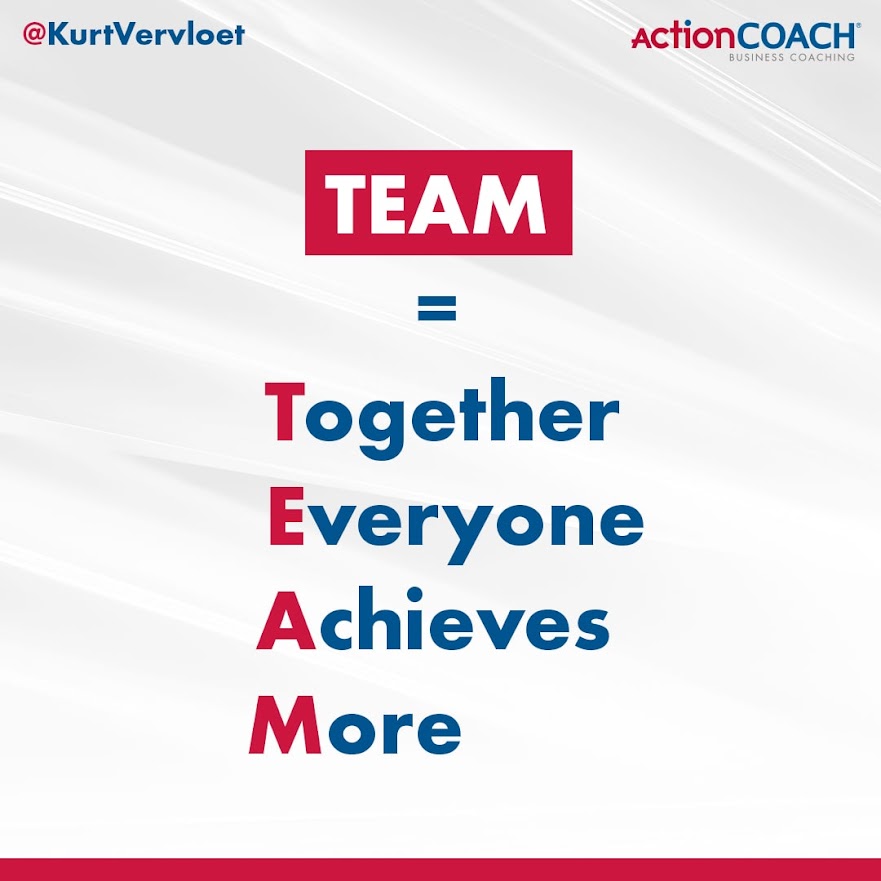
team acroniem

What is coaching?

Coaching is a specific form of leadership tailored to the individual needs of one employee or an entire team. By giving them space to create their own results, you involve your staff in the organisation of the company. Together, they feel responsible for a particular task, which motivates them to complete it successfully.

In short, a coach therefore adjusts work processes to make them run more smoothly, but in practice there is obviously a lot more to it than that. The self-confidence of your employees, their characters, interpersonal relationships... all have an impact on the group dynamics and the internal functioning of the team.

Difference between coach and manager

Managers are focused on concrete results and business processes. A coach keeps that in mind, but focuses on the personal journey of his people and the meaning in the tasks they perform.

You can always manage, you only coach when your team is actually experiencing a problem and in need of guidance. Moreover, you have to deliver some typical managerial behaviour to do so:

Look at yourself

Is there a conflict or is a process not going as smoothly as it could? Then ask yourself what role you yourself play in it. Dare to admit your mistakes and adjust your own behaviour if necessary. Otherwise, you cannot expect that from your team.

Support without filling in

The team itself takes responsibility for completing tasks and making decisions. As a coach, you are responsible for supporting that process, but leave the interpretation to the team. Focus rather on the development of good qualities of your team members, than on how to get a result.

Learn to listen

As a leader, you are used to making decisions, but as a coach, you have to listen especially well and from there support your team so that they can decide for themselves. This involves not only the content of the message, but also the way it is conveyed. That says a lot about the underlying relationship and tension.

How to coach my team

  • Safe learning environment
    A good coach is attentive to his team's insecurities and conflict-sensitive issues. Therefore, create a safe environment where it is okay to make mistakes and where there is open communication. Teach your team to put situations into perspective and provide enough humour so that the process does not become too heavy.

  • Concrete objectives
    Instead of saying "we want to spend less time on administration", set a measurable objective with the expected outcome and lay out the resources and schedule needed to achieve it.

  • Regular feedback sessions
    Organise structured meetings to evaluate preliminary results, discuss what is going well and make adjustments where necessary. This cyclical follow-up ensures that everyone stays engaged and no one forgets the goal.

  • Ask questions
    As a coach, you do not give instructions, but let the team come to its own insights by asking the right questions. In doing so, don't dwell too long on the cause of problems, but focus on how things can be done differently.


Characteristics of a good team coach

A good coach...

Can deal with uncertainty

Dare to let go of control and accept the situation as it is.

Observes the behaviour of team members

Relates or confronts, depending on the situation.

Slow to respond

Because he trusts that the right outcome will emerge naturally by letting the team search for itself.

Challenge his team

Challenges his team to try things in a different way than they are used to.

Coaching a team: the pitfalls

As a coach, try to avoid these situations:

  • Mediating too early or too late
    Mediate at the moment your team asks for it.

  • Trying to avoid any negative effect
    Let the team learn from their mistakes.

  • Approaching team members individually
    Coach in group.

  • Downplay or ignore the mood of the team
    Leave room for emotions.

  • Losing your coaching position because you get sucked into the team
    Keep a healthy distance.

Note: You cannot coach every team yourself.

If your own part in the situation to be mediated is too big or there is no click with the team, it is better to ask another party to coach. For example, the team leader of another department or an HR employee who can keep more distance and be neutral.

Reading tip:  How do you find the right talent for your business?

More tips on team coaching?

Team coaching creates smoother business processes with attention to the people running them. At ActionCOACH, we help entrepreneurs guide their teams to create productive and streamlined business processes.

Kurt Vervloet

Kurt Vervloet is a business coach, blogger and speaker. Since 2017, he has been coaching businesses around the world, ranging from solo entrepreneurs, SME companies to executive management teams at large organisations. His clients choose to work with him because of my proven, no-nonsense approach to optimising and scaling businesses. By achieving great results with his clients, he has already been rewarded with several Awards.