
How marketable is your business?

Hoe verkoopbaar is jouw bedrijf?
BLOG

How marketable is your business?

The main reason to start a business might be to sell it one day. It is the way to become really wealthy; buy (or build) businesses, make them further big and then sell them.

In general, you won't really accumulate much wealth if you only have one business. You will have to buy, build and sell a business several times to become truly wealthy.

Ideally, the only time you would want to keep a business should be if you wanted to turn it into a franchise or licensing model. However, this is a completely different situation, with different considerations, processes and requirements.

A good strategy is to hold on to your first business for the passive income it generates while you buy and build your next business. At this point, your first business should be at such a level that it runs successfully without your presence.

This then generates passive income and eases the pressure when selling, allowing you to take your time to find the right buyer and negotiate the best possible deal.

It is important to understand that you need to be a good negotiator if you are going to sell the business yourself. You are aiming for the best possible price and to achieve this, the business needs to be at a point where it is fully 'up and running'. In fact, the buyer can just move in and start earning right away.

Five key factors

There are a number of factors that affect the ability to sell your business and the price buyers will be willing to pay for your business.

These factors are as follows:

Strong consistent cash flow

One of the most important factors influencing the company's sales is its ability to generate a high percentage of repeat purchases. A regular customer base that buys from you with regularity is very valuable.

Owned assets

Here, a potential buyer will look at what assets the company owns. Be it products, registered trademarks, investments, stakes in other companies that are also part of the sale and the physical assets (movable and immovable).

People, processes and systems

Every business needs systems and good people to make sure you have a commercial, profitable business that works without the business owner.

Scalability of the business

The buyer will always want to ensure that the business is scalable so that it can get more value out of the business after the business is bought. If there is no scalability built in, the buyer has bought additional revenue but no future 'leverage' with the acquisition.

Culture of the organisation

This is often an area that is overlooked. Research shows that around 80% of acquisitions fail due to the inability to fully integrate the respective teams into one cohesive operational unit.

Start from the beginning

The key to making sure your business is marketable is to work on the above five areas from the start and develop them over time.

Too many entrepreneurs wait until the moment they want to sell and only then start analysing how 'marketable' their business is.

The reality is that many acquisitions happen when you least expect them. Or when the entrepreneur wants to transfer or sell the business because he or she wants to 'retire' and has never consciously worked towards this.

It is therefore important to work towards a sale with your business from the start. Then you will be much better prepared when a buyer presents itself and you will be able to maximise the sales price.

How we help

The ActionCOACH approach focuses on helping you build a business that can work without the business owner. Our '6 Steps to a Successful Business' model is all about this. In all our coaching programmes - both individual and group - we work with you towards this.

Kurt Vervloet

Kurt Vervloet is a business coach, blogger and speaker. Since 2017, he has been coaching businesses around the world, ranging from solo entrepreneurs, SME companies to executive management teams at large organisations. His clients choose to work with him because of my proven, no-nonsense approach to optimising and scaling businesses. By achieving great results with his clients, he has already been rewarded with several Awards.


The 5 ways: a formula for exponential growth

actioncoach
BLOG

The 5 ways: a formula for exponential growth

Entrepreneurship can be learned! At ActionCOACH, we introduce you to the key formula for entrepreneurship. 

We work with "The 5 Ways" formula to exponentially multiply profits in your business.

5 Ways

ActionCOACH shows that there are just five components that can grow a business exponentially: 

  • Leads 
  • Conversion rate 
  • Repeat purchases 
  • Average order size
  • Margins

Leads (1)

Leads multiplied by conversion equals the number of customers. Who or what are your leads? These are potential customers, those who have contacted you. 

Conversion (2)

Conversion is the percentage of leads you turn into customers. These are the ones who have actually bought from you.  

Repeat purchases (3) & Average Order Size (4)

When you then multiply the number of customers by the number of transactions - which are repeat purchases - and the average amount per order or sale, that gives you your total sales, total revenue. 


Margin (5)

If you multiply your total sales by the margins you use, you arrive at your total profit. 

Many recruitment agencies also operate as employment agencies. This way, you can also test an employee to see if they ultimately meet your expectations.

So what about Customers, Profit and Turnover?

People usually ask about customers, turnover and profit. But above, we don't mention them and they are in red in the image below. Why? They are the least important! 

Instead, it is the results of the other five key metrics. The key factors you can work on are the number of leads, your conversion rate, your repeat purchases or number of transactions, your average order size and your margins.

Let's enter a few numbers for clarification (or watch the video at the very bottom of this page for the maths): 

Suppose you had 4,000 leads in your business year last year and you sold to one of the four, or 25%. Then that means you had 1,000 customers in your business. Now suppose they came back twice a year on average to buy something from you.

Some came 100 times, some once and some never again, but the average was twice. We multiply that by the average sales amount. For this example, let's take €100 as the average sales amount.

Doing this sum gives €200,000 in sales in this SME - 1000 (customers) x 2 (repeat purchases) x €100 (average expense) is €200,000 in sales. If we then use a profit margin of 25%, for example, you take home €50,000 profit.  

Now we are going to work on the five factors. We are not going to try to double them, nor are we going to do any hocus pocus. We are going to improve them each by 10% and then by 30%. See the numbers in the image below? Those are rising tremendously. 

tabel

 Now for you, you may be increasing 10% in one area and in another area 20% or 30% or even more... Real results for growing your business are achieved by working on these '5 ways'.  

Let us help you make the 5 Ways work for your business and grow your profits! 

Contact us. 

Kurt Vervloet

Kurt Vervloet is a business coach, blogger and speaker. Since 2017, he has been coaching businesses around the world, ranging from solo entrepreneurs, SME companies to executive management teams at large organisations. His clients choose to work with him because of my proven, no-nonsense approach to optimising and scaling businesses. By achieving great results with his clients, he has already been rewarded with several Awards.

Leverage in entrepreneurship

Hefboomeffect in ondernemen
BLOG

Leverage in entrepreneurship

What is leverage in entrepreneurship? It comes down to getting the best out of your people, systems and processes!

Let's break down leverage into 4 facets.

Part 1: People & education

Are you getting the best out of your team? Are they getting regular training or updates so that they can grow professionally, thus helping your business grow too? Are you delegating? If not, why not?

Doing it right not only frees up time, but it also gives your employees the chance to take on more responsibility and their motivation increases as well.

Regular reviews/assessments help, especially if there is the opportunity for 360-degree feedback. It is also important to look at your team's productivity - perhaps you have found that productivity has increased because people are working from home - if so, how/why?

Part 2: Delivery & distribution 

This has everything to do with the delivery of your service/product to customers/clients. Do you consistently deliver excellent service worth 5 stars? 

Whether it is or not; regularly review your systems/processes and make sure they are fit for purpose, now and in the future. Any necessary changes will work better if you involve your team. 

Anything that is not automated when it could be, thus becomes worthwhile and covers 80% of situations, leaving only 20% requiring human intervention. Then this is where your staff handbook and training programme comes in.

Without such a manual, you will have to constantly tell your team what to do. A business manual and regular training also ensure that your standards are consistent. This means you spend less time resolving issues with clients or customers and you and your team can focus on making money. 

Part 3: Accounting & financial processes 

As an entrepreneur, you need to know your numbers. We cannot stress enough how important this is. Measuring = knowing.

How can you know how you are doing if you have no information about your starting point, or your current position! I don't just mean the typical € numbers, but also numbers like number of products/services sold, number of leads, number of customers, number of webinar attendees and conversion rates,... Know ALL the numbers!

Know your sales figures, costs, profit margins and make sure you set Key Performance Indicators (KPIs) for all areas of your business. This will help you visualise how successful (or not) each area of your business is. It will also allow you to see where valuations or improvements are needed. 

Making sure each member of the team knows their individual KPIs means they are able to see the value they bring and also helps keep them motivated to do their best. There might even be room for a little friendly competition. 

Part 4: Systems & technology 

Having the right systems and technology in place will help streamline your operations. For example, a CRM (customer relationship management) system will allow you to manage your dealings with your customers.

This system not only records who your customers are, it can also track sales, profitability, feedback on what they bought and what marketing material you sent them.

With this information, you can better target customers with your products and services. Start with a flowchart for each area of your business, this will help you identify any bottlenecks 

Automate routine tasks or outsource them as this will free up your time. This could be payroll, administrative tasks such as billing clients and managing social media. 

Used properly, accounting software can also be a huge benefit. It allows you to create regular reports that clearly show the profitability or lack thereof of each part of your business, saving you time and effort.

All this will help you shift from working IN to working ON your business. 

Don't forget the practical manuals that everyone can use - keep them. If you apply these techniques, you will grow your business.

Kurt Vervloet

Kurt Vervloet is a business coach, blogger and speaker. Since 2017, he has been coaching businesses around the world, ranging from solo entrepreneurs, SME companies to executive management teams at large organisations. His clients choose to work with him because of my proven, no-nonsense approach to optimising and scaling businesses. By achieving great results with his clients, he has already been rewarded with several Awards.
Stop blaming time

Stop met de tijd de schuld te geven
BLOG

Stop blaming time

How often have you heard people say, "I don't have enough time to do it ..." or "If only I could find the time to do X ..." Or "I'm too busy to do Y ..." Maybe the person you hear saying these - or similar - things is the same person who stares at you in the bathroom mirror every morning.

Now, it's time to stop blaming time!

Time is absolute - there are 24 hours (1440 minutes, 86,400 seconds) in a day and that will never change. We cannot 'manage' time.

What we can manage, however, is what we do in the next 60 minutes. How we use time is one of the big determinants of how successful we are. As business owners and as individuals.

Everyone from Bill Gates to the SME gets 24 hours, the same amount of time every day. Think of it as the car races where they make all drivers drive identically built and tuned race cars.

The winner is not determined by who has the fastest car, but who can drive the identical car the best. Similarly, the 'winners' in life are those who learn how best to spend their time.

So how do you get a grip on your time?

1. Accept that there is no such thing as too much or too little time

There is enough time available for you to be successful. Others have been successful and they did not have access to more time than you.

Take ownership of your situation. Take responsibility for your results and be accountable for your actions.

2. Define what you want to achieve

What do you want to be 'successful' at?

For some this might mean a million euros in the bank, for others it might mean being healthier.

Others may be looking for better relationships with their family and friends. This is your goal. You should also be clear on why you want to achieve this goal and what it will mean to you - what feeling will it give you when you achieve it?

Both the goal and your "why" should be noted with a timeframe.

3. Define activities

Having defined the goal and your "why", you then need to determine the activities needed to achieve that goal.

What should I do? How much time do I reserve for it? What do I need to adjust/sacrifice/reduce/delegate to find the time to do what it takes? Remember, if everyone else found it easy, you too would have already done it.

What distinguishes successful time users from unsuccessful ones is the discipline and determination to achieve their goals, no matter what. Winners never give up and they never lose faith in themselves.

4. Understand that life and business are about making choices

You choose how you spend your time - what activities you undertake and how much time you spend on them. This is a marathon, not a sprint.

Being successful in many different areas takes effort and time. Success comes from razor-sharp focus on one or two goals. Once they are completed, move on to the next set of goals and focus on them.

5. Agreements with yourself

Prepare your calendar weekly by making "appointments" for the activities you have identified. By default, these are placed first in your calendar before everything else.

Treat this as if it were an appointment with your most important client. Would you change that appointment with your most important client on Monday from 2pm to 3pm just because someone asked for that time?

No, you would negotiate ... 'I'm booked at that time. I'll see you at 1pm or after 3pm, which suits you best?'

6. Be militant about your schedule

If you don't care how your time is spent, why should anyone else care?

Learn to say 'no'. In Stephen Covey's book "7 Habits of Highly Effective People", activities are divided into 4 categories: not important/not urgent, urgent/not important, urgent/important and not urgent/important.

The danger for most people is the urgent/not important category. This is when we respond to other people's urgencies, but that activity does not get us to OUR goal. By definition, it is not important.

Beware of the time and effort you spend on these tasks. Conduct your own time-use study. Every minute you can convert from the non-important categories to the important ones will bring you closer to your goal.

7. Analyse your successes/challenges in sticking to your schedule weekly and adjust where necessary

Be honest with yourself and constantly reinforce your "Why". What are you trying to achieve and how important is it to you.

8. Find an 'accountability' partner or coach to keep you on track

We can all use this help - admitting this is a strength, not a weakness.

In short, stop blaming time, take ownership of your time and commit to the necessary discipline to win the race by being the best "driver" of time you can be. And get a coach to keep you on track.

Kurt Vervloet

Kurt Vervloet is a business coach, blogger and speaker. Since 2017, he has been coaching businesses around the world, ranging from solo entrepreneurs, SME companies to executive management teams at large organisations. His clients choose to work with him because of my proven, no-nonsense approach to optimising and scaling businesses. By achieving great results with his clients, he has already been rewarded with several Awards.

How do I coach my team?

actioncoach
BLOG

How do I coach my team?

As entrepreneurs, we are used to blazing through, but not all employees can handle that equally well. Sometimes a team's work process requires a little more attention. In this article, you will read more about how you can coach your team to make your employees happier and more productive.

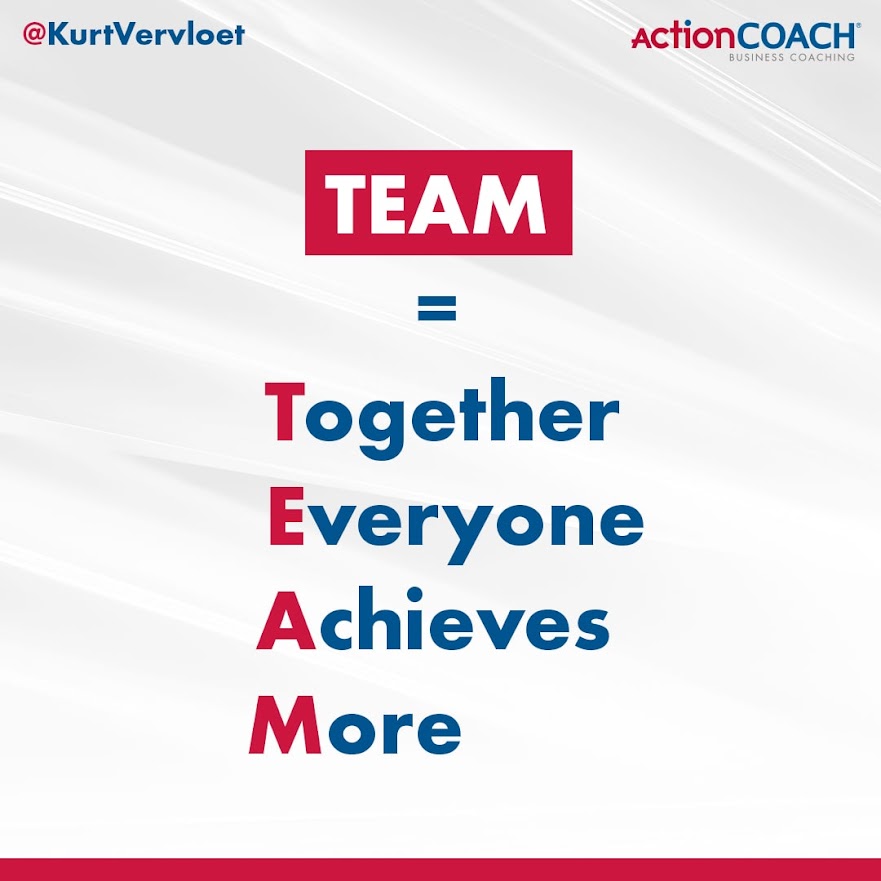
team acroniem

What is coaching?

Coaching is a specific form of leadership tailored to the individual needs of one employee or an entire team. By giving them space to create their own results, you involve your staff in the organisation of the company. Together, they feel responsible for a particular task, which motivates them to complete it successfully.

In short, a coach therefore adjusts work processes to make them run more smoothly, but in practice there is obviously a lot more to it than that. The self-confidence of your employees, their characters, interpersonal relationships... all have an impact on the group dynamics and the internal functioning of the team.

Difference between coach and manager

Managers are focused on concrete results and business processes. A coach keeps that in mind, but focuses on the personal journey of his people and the meaning in the tasks they perform.

You can always manage, you only coach when your team is actually experiencing a problem and in need of guidance. Moreover, you have to deliver some typical managerial behaviour to do so:

Look at yourself

Is there a conflict or is a process not going as smoothly as it could? Then ask yourself what role you yourself play in it. Dare to admit your mistakes and adjust your own behaviour if necessary. Otherwise, you cannot expect that from your team.

Support without filling in

The team itself takes responsibility for completing tasks and making decisions. As a coach, you are responsible for supporting that process, but leave the interpretation to the team. Focus rather on the development of good qualities of your team members, than on how to get a result.

Learn to listen

As a leader, you are used to making decisions, but as a coach, you have to listen especially well and from there support your team so that they can decide for themselves. This involves not only the content of the message, but also the way it is conveyed. That says a lot about the underlying relationship and tension.

How to coach my team

  • Safe learning environment
    A good coach is attentive to his team's insecurities and conflict-sensitive issues. Therefore, create a safe environment where it is okay to make mistakes and where there is open communication. Teach your team to put situations into perspective and provide enough humour so that the process does not become too heavy.

  • Concrete objectives
    Instead of saying "we want to spend less time on administration", set a measurable objective with the expected outcome and lay out the resources and schedule needed to achieve it.

  • Regular feedback sessions
    Organise structured meetings to evaluate preliminary results, discuss what is going well and make adjustments where necessary. This cyclical follow-up ensures that everyone stays engaged and no one forgets the goal.

  • Ask questions
    As a coach, you do not give instructions, but let the team come to its own insights by asking the right questions. In doing so, don't dwell too long on the cause of problems, but focus on how things can be done differently.


Characteristics of a good team coach

A good coach...

Can deal with uncertainty

Dare to let go of control and accept the situation as it is.

Observes the behaviour of team members

Relates or confronts, depending on the situation.

Slow to respond

Because he trusts that the right outcome will emerge naturally by letting the team search for itself.

Challenge his team

Challenges his team to try things in a different way than they are used to.

Coaching a team: the pitfalls

As a coach, try to avoid these situations:

  • Mediating too early or too late
    Mediate at the moment your team asks for it.

  • Trying to avoid any negative effect
    Let the team learn from their mistakes.

  • Approaching team members individually
    Coach in group.

  • Downplay or ignore the mood of the team
    Leave room for emotions.

  • Losing your coaching position because you get sucked into the team
    Keep a healthy distance.

Note: You cannot coach every team yourself.

If your own part in the situation to be mediated is too big or there is no click with the team, it is better to ask another party to coach. For example, the team leader of another department or an HR employee who can keep more distance and be neutral.

Reading tip:  How do you find the right talent for your business?

More tips on team coaching?

Team coaching creates smoother business processes with attention to the people running them. At ActionCOACH, we help entrepreneurs guide their teams to create productive and streamlined business processes.

Kurt Vervloet

Kurt Vervloet is a business coach, blogger and speaker. Since 2017, he has been coaching businesses around the world, ranging from solo entrepreneurs, SME companies to executive management teams at large organisations. His clients choose to work with him because of my proven, no-nonsense approach to optimising and scaling businesses. By achieving great results with his clients, he has already been rewarded with several Awards.